How to Play the D chord on Banjo in Standard Tuning
The D chord on banjo is one of the first three chords (along with G and C) that you should learn if you want to play out of standard tuning. Knowing just these three will let you play a ton of old time songs! The D chord is used in classic songs like Cripple Creek, Boil Them Cabbage Down and Will The Circle Be Unbroken.
How to play the D Major chord on the banjo
There are several versions of the D chord commonly used on the banjo. We'll walk you through where to place your fingers for the D major, D7 and Dsus4 - the 3 most common D chords played in open G tuning. We'll also use banjo chord charts to show you exactly where to place your fingers for each version of the chord.
First, make sure your banjo is tuned to standard G:
- G - The 5th string (the short string with the highest tone)
- D - The 4th string (lowest tone)
- G - The 3rd string
- B - The 2nd string
- D - The first string
And here's how to read the chord charts:
- The strings are read from left to right, starting with the 4th string all the way on the left to the 1st string on the right. We don't display the 5th string in these charts because we don't fret it.
- A blue "O" above the string means that the note is left open. Don't press down that string at all.
- The number one means you should press with your index finger.
- The number two means you should press with your middle finger
- The number three means you should press with your ring finger
- The number four means you should press with your pinky (don't worry, we're not using the pinky today!)
So let's break down the D major chord chart.
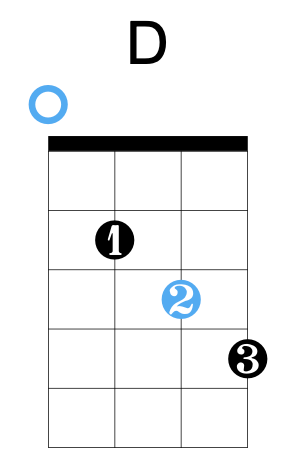
- The 4th (lowest tone) string is left open..
- Use your index finger to fret the third string at the second fret.
- Use your middle finger to fret the second string at the third fret.
- Use your ringer finger to fret the first string at the fourth fret.
- Then strum all the strings! That's a D major chord.
Your first alternative, the D7 chord
It's very common to see alternatives to the D major chord substituted. They are slightly easy to play, and they add a lovely sense of tension you're playing in the key of G. The first of these we'll look at is the D7. The D7 adds a C to the chord. Here's the chord chart for it:
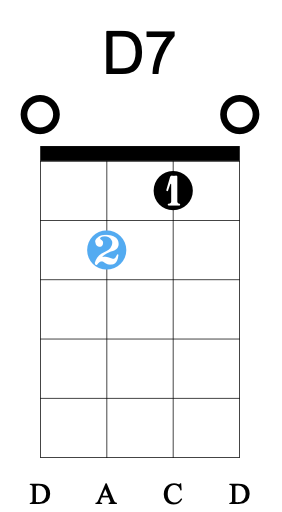
To play the D7 chord:
- Use your middle finger to fret the third string at the second fret.
- Use your index finger to fret the second string at the first fret.
- And voila! Strum all the strings and you've got a D7.
My personal favorite alternative - the Dsus4
The Dsus4 - which means D Suspended Fourth adds even more tension to the D chord. The major chord is D F# A. By moving that F# up half a step, we remove the quality that makes the D chord major or minor. Unless you're a nerd like me, you probably don't have to worry about all that. Just know that when you hear a Dsus4 chord in a song, it creates a tiny mystery in your ears - where you're not sure if the song is going to a major or minor chord. It adds interest to the song and makes you want to know what's coming next. Here's the chord chart for it:
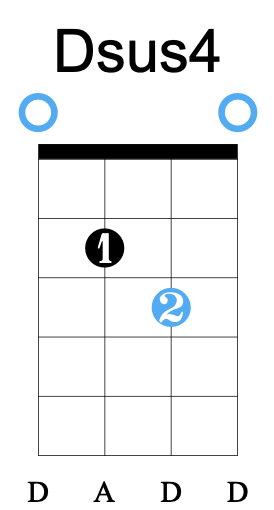
And here's how to play it:
- Use your index finger to play the third string at the second fret.
- Use your middle finger to play the second string at the third fret.
- Strum all the strings, and you have your Dsus4!
Conclusion
Give the D major chord and its alternatives a try. And practice using them interchangeably, to see what you like where. You'll be surprised how the right changeup can really make a song sound great.